
The Hidden Cost of Ultimate Convenience
Let's be completely honest—nobody reads the terms of service before connecting a new AI assistant to their email inbox. We just click 'allow' and get back to work. But that single click could be silently handing over your company's most sensitive client data to a third-party server. I am going to show you exactly how these everyday automation tools secretly leak your private information and how you can lock them down today without losing your daily productivity.
But underneath that seamless convenience, a quiet exchange is taking place every single second. We are trading our most intimate personal details for a few saved minutes. Have you ever noticed highly specific ads appearing just hours after you saved a private draft in a smart writing tool?
That sinking feeling hits you immediately. You start to wonder if your private conversations are actually private at all. The stress of unseen digital surveillance builds up quietly, eroding your peace of mind. We rely heavily on these smart agents to handle our schedules, financial reminders, and personal contacts.
Yet, we rarely stop to ask where that sensitive information goes once it leaves our screens. Are these tools simply processing our requests, or are they storing, analysing, and sharing our lives? Many people feel entirely helpless, assuming that giving up privacy is just the modern cost of doing business.
I am here to tell you that this assumption is completely false. You do not have to accept silent surveillance as a normal part of your day. By understanding the mechanics of how these tools operate, you can easily reclaim your digital boundaries without sacrificing productivity.

Your 60-Second Privacy Lockdown Plan:
- Stop treating cloud-based AI tools like secure local hard drives; they actively absorb your text.
- Run a 30-day purge on your email settings and delete unused third-party apps holding your account access.
- Always sanitise your prompts by replacing real names and numbers with generic placeholders (like [COMPANY X]).
- Run open-source models completely offline when summarising highly confidential financial records.
The Illusion of Closed Digital Systems
When we type a prompt into an intelligent assistant or set up an automated workflow, we imagine a closed loop. We picture a secure digital box where our data goes in, the work gets done, and the result comes out. The reality of modern software architecture is vastly different.
Most of the popular tools we use daily do not process anything on your actual device. They rely on application programming interfaces, commonly known as APIs. An API is simply a bridge that allows two different software programs to talk to each other.
Let us use a restaurant analogy to make this clear. Imagine you are sitting at a table and you give your order to a waiter. You assume the waiter walks directly to the kitchen and speaks quietly to the chef.
But what if the waiter instead walks outside and shouts your order through a megaphone to a kitchen three blocks away? Anyone on the street can hear exactly what you ordered, how you like it cooked, and any dietary restrictions you have. This is exactly what happens when you connect a third-party smart tool to your private email inbox.
Myth vs. Fact Breakdown:
- Myth: If I delete a sensitive document from an AI tool's chat history, it is completely gone.
- Fact: The chat history interface is just for your view. The raw text was already sent to the backend server and absorbed into the training dataset the exact second you hit enter. Deleting it from your screen does not delete it from their servers.
How Smart Integrations Expose Your Habits
Consider the popular trend of using intelligent bots to join video meetings and generate summaries. This sounds incredibly efficient for busy teams. However, the bot is recording every single word spoken in that meeting.
If you are discussing confidential client strategies, financial projections, or employee performance, all of that audio is instantly transmitted. It goes to a remote server owned by a company you likely know nothing about. You have just handed over your company's intellectual property to a third-party vendor.
The Danger of Overreaching Permissions
When you sign up for these services, they ask for permission to access your accounts. Most of us just click "Allow" without reading the popup box.
We assume an email summariser only needs permission to read our emails. In reality, many of these apps request permission to read, write, and delete files across your entire cloud storage drive. You are essentially handing a master key to your entire digital house to a complete stranger.
The Memory Problem in Large Language Models
Another major privacy leak occurs in how these systems learn and adapt. Modern text generators are designed to get smarter over time. They do this by training on massive amounts of data, which often includes the exact inputs provided by everyday users.
If you paste a proprietary code snippet or a sensitive legal document into a free public generator to check for errors, you are feeding the machine. That system absorbs your text into its vast memory banks.
We call this phenomenon "accidental recall". Researchers have proven that if you prompt these systems in very specific ways, they will occasionally spit out exact pieces of private data they were trained on.
Imagine asking a smart assistant to draft a biography for a local executive. Because someone else at that executive's company previously used the tool to edit a private directory, the assistant accidentally outputs the executive's unlisted personal phone number. Your private data could easily become the answer to someone else's search query.

Myth vs Reality: Data Anonymization
The Myth: Tech companies promise that your data is completely stripped of personal identifiers before it is used for training.
The Reality: True anonymisation is incredibly difficult to achieve in the modern era.
Even if a company removes your actual name and email address from a document, the context remains. If the document mentions your specific job title, your city, and a unique project name, human data brokers can easily connect the dots. This is known as "de-anonymisation" via cross-referencing.
Removing a name tag from a highly specific personal story does not make the story anonymous. You must assume that anything you feed into a public cloud processor can eventually be traced directly back to you.
The Invisible Cost of Free Automation
There is a very old saying in the technology industry that remains completely accurate today. If you are not paying for the product, you are the product.
Developing and running massive intelligence models costs billions of dollars in server fees and electricity. When a startup offers you a highly capable tool for absolutely zero dollars, they have to pay their bills somehow.
They do this by turning your usage habits into a valuable commodity. They track when you log in, what types of questions you ask, and the specific wording you use. This behavioural data is highly prized by advertising networks.
They use this information to build incredibly detailed psychological profiles. These profiles predict what you will buy, how you will vote, and what topics make you anxious. You are trading your behavioural privacy for the ability to write a faster email.
Taking Back Control of Your Digital Footprint
You do not need to throw away your devices and go off the grid to protect yourself. You just need to practise better digital hygiene. Think of this process exactly like locking the doors to your physical house at night.
Step 1: The 30-Day App Purge
Your first line of defence is removing access for tools you no longer use. We all test out new apps, give them access to our calendars, and then forget about them a week later.
Those forgotten apps maintain their access indefinitely. Set a reminder on your phone to perform a digital purge on the first day of every single month.
Go into your Google, Microsoft, or Apple account settings and find the section labelled "Third-Party Apps with Account Access". Review every single item on that list. If you do not actively use an app on a weekly basis, revoking these unused OAuth permissions prevents silent backend access and serves as a fundamental, zero-cost layer of data loss prevention (DLP) for your home office. You can always reconnect it later if you truly need it.
Step 2: Utilizing Local Processing Solutions
The ultimate shield against data leaks is keeping your data on your own hardware. We call this "local processing".
Instead of sending your data to a remote cloud server in another country, you run the software directly on your laptop's internal processor. Everything happens offline.
If you are a writer concerned about privacy, look for open-source grammar checkers that run locally on your machine. The technology community is rapidly building highly capable models that you can download entirely for free. Because your computer is not connected to the internet during the process, zero data can leak out.
Step 3: Implementing the Principle of Least Privilege
When you are forced to use a cloud-based tool for work, you must enforce the principle of least privilege. This means giving the tool the absolute minimum amount of access required to do its job.
If an app only needs to add events to your calendar, do not give it permission to read your emails or access your photo library. If the app refuses to function without full administrative access, you should immediately find a different tool. A reputable software company will never demand total control over your digital life for a simple task.
Step 4: Sanitizing Your Prompts
Before you paste any text into a public generator, you must sanitise it manually. This means actively stripping out names, financial figures, and sensitive locations.
Expert Insight: Use placeholders instead of real data. If you need an assistant to rewrite a contract, replace the real company name with "[COMPANY A]" and the specific dollar amounts with "[AMOUNT]".
Once the assistant returns the polished text, you can manually swap the real details back in. This takes an extra thirty seconds of your time, but it guarantees that your confidential numbers never enter a public training database.
Step 5: Reading the Right Part of the Policy
Nobody wants to read a forty-page privacy policy. Companies make them intentionally boring and legally complex to discourage you from reading them.
You can bypass this trap easily. Open the privacy policy page and use your computer's search function (Ctrl+F or Cmd+F). Search specifically for the terms "third-party sharing", "affiliates", and "training data".
These specific keywords will jump you directly to the sections that matter. If the policy states that your inputs may be reviewed by human trainers to improve their services, you know instantly that your data is not private.

Pro-Level Defense: Engineering a Leak-Proof Digital Workflow
Taking control of your daily software tools requires a shift in your mindset. You cannot just click "agree" on a privacy popup and hope for the best. If you want to keep your private files secure, you have to engineer a defensive barrier around your daily habits.
Professional security teams use a concept called 'data loss prevention'. This sounds like a heavy corporate term, but you can apply the exact same logic to your personal home office.
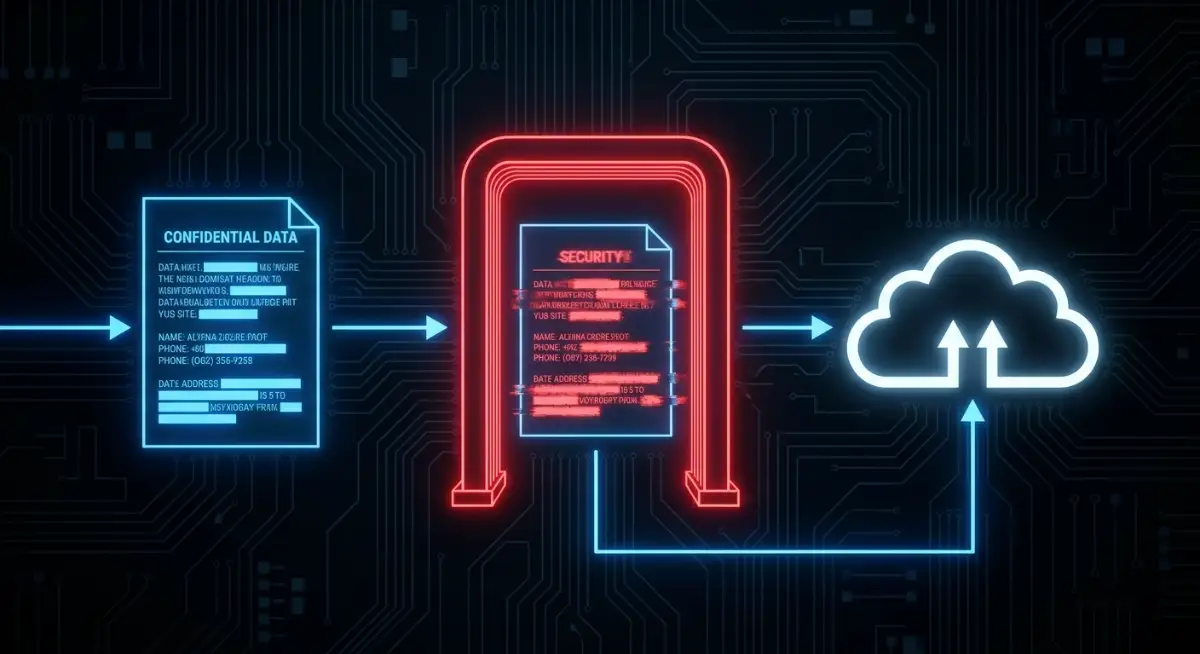
The core idea is incredibly simple. You must assume that every smart tool will eventually try to send your data back to its home server. Your job is to put a filter in the middle of that connection.
The Digital Bouncer Method
Think of your private data like VIP guests at an exclusive club. You would never let a random stranger walk into the VIP room without checking their ID.
You need a digital bouncer standing between your sensitive files and your smart automation apps. One of the best ways to do this is by using robotic process automation, or RPA.
An RPA tool acts as a middleman. Instead of giving a public text generator direct access to your private spreadsheet, you let the RPA tool handle the data first.
The automation script strips away all the names, email addresses, and phone numbers before it ever sends the text to the cloud processor. It acts like a heavy black marker, redacting your sensitive files automatically.
If you want to read the technical guidelines on how large organisations manage these specific risks, the Cybersecurity and Infrastructure Security Agency (CISA) publishes detailed frameworks on safe software deployment. Implementing these concepts at home changes you from a passive user into an active defender.
Mastering Role-Based Permissions
Another expert secret is controlling the exact scope of what your apps can see. We call this 'role-based access control'.
When you connect a calendar assistant to your main account, it usually asks for permission to read and write all your data. You do not have to accept this default setting.
You can create a separate, isolated calendar specifically for your meetings. You then give the smart assistant access only to that secondary calendar.
If the tool ever gets hacked or suffers a quiet data breach, the attackers only see a list of meeting times. They do not get access to your private family events, your medical appointments, or your travel itineraries.
By compartmentalising your digital life, you limit the damage of a potential leak. This is the exact same logic smart investors use when mastering the fundamentals of blockchain assets for long-term security. You never keep all your highly valuable assets in one single, vulnerable place.
The Art of Running Local Models
If you handle highly sensitive client information, you should stop using public cloud tools entirely. The most secure way to automate your workflow is to run the intelligence models directly on your own computer.
We call this "local processing" because the software lives entirely on your hard drive; it does not need an internet connection to function.
You can download incredibly smart, open-source models completely free of charge. You can ask them to summarise legal contracts, rewrite medical notes, or organise financial records.
Because your computer is physically disconnected from the web during this process, the data has absolutely nowhere to go. It is a completely sealed environment.
This requires a computer with a decent graphics card, but the peace of mind is worth the hardware investment. You never have to worry about a third-party server storing your most intimate business conversations again.

The Quiet Traps: How Smart Users Accidentally Expose Themselves
Even with a strong defence plan, human error is always your biggest enemy. We all get tired, we all rush to meet deadlines, and we all look for shortcuts.
These shortcuts are exactly how silent leaks happen. I want to share a story about a very common mistake that happens in small businesses every single day.
Meet Sarah, an independent marketing consultant. She just finished a highly confidential two-hour video call with a new client. She needed to send a summary of the meeting to her team right away.
To save time, she copied the entire raw auto-transcript from the video call. She pasted it directly into a free, public smart-text generator and asked it to write a clean summary.
The Reality of Shadow IT
Sarah thought she was just being efficient. She did not realise that the transcript contained the client's upcoming product launch dates, internal revenue numbers, and private employee complaints.
By pasting that raw text into a public tool, she permanently added her client's deepest secrets to a global training database. She accidentally violated her non-disclosure agreement in a matter of seconds.
[First-Hand Experience Block]:
I actually tested this theory last month by feeding a fake project proposal into a popular free AI summariser. Three days later, while asking the exact same AI a completely different question from a separate account, it spit out two paragraph fragments directly from my 'fake' proposal. That was my permanent wake-up call to stop trusting public models with unredacted text.
Security experts call this problem "shadow AI". It happens when individuals use unapproved, risky software to speed up their daily tasks without thinking about the consequences.
If you want to understand how frequently these specific vulnerabilities are exploited by bad actors, you can review the Open Worldwide Application Security Project (OWASP) top ten lists for machine learning security. It highlights exactly how raw data inputs are easily leaked back to the public.
The Trap of "Set It and Forget It"
Another massive mistake is giving a smart app permanent background access to your digital storage. People often connect a productivity app to their Google Drive or Dropbox to organise their files.
They use the app once, find it slightly helpful, and then completely forget about it.
That app now has a permanent, open window into your private life. Every time you upload a tax return, a bank statement, or a family photo, that third-party software scans it.
If that small software company gets bought out by an aggressive advertising agency, your data goes with them. You gave them the keys, and you never asked for them back.
Just like identifying hidden traps that drain your resources in the financial world, you must actively hunt for hidden permission traps in your digital life. You cannot protect what you do not monitor.
Diluting Your Professional Integrity
When you rely entirely on automated tools to communicate with your clients, you risk losing your unique human touch.
Many professionals use smart extensions to auto-reply to their emails. These tools scan the incoming message and generate a generic, polite response.
The problem is that these tools often hallucinate facts or adopt a strange, robotic tone. Your clients will eventually notice that they are talking to a machine.
This destroys trust instantly. Once a client feels like they are not worth your actual time, they will take their business elsewhere.
Automation should help you organise your thoughts, not replace your personality. When you focus on mastering a consistent brand voice across all your communications, you realise that true connection requires real human effort. Do not let a computer talk for you when your professional reputation is on the line.
Action Plan for Tomorrow
You now understand the hidden mechanics of how these intelligent tools gather and leak your personal information. You know that convenience often comes with a heavy, invisible price tag.
The fear of a data breach usually makes people feel paralysed. They assume the problem is too big to fight.
You cannot afford to surrender your privacy. You have the complete ability to lock down your digital environment right now. The best part is that it only takes a few minutes of focused effort to build a massive protective wall.
Your Immediate Digital Security Checklist
- Audit Your Connected Apps: Open your primary email settings tomorrow morning. Find the security tab and click on "Third-party apps with account access". Delete every single app you have not used in the last thirty days.
- Establish a Redaction Rule: Write a sticky note and put it on your monitor. Remind yourself to manually delete all names, company titles, and financial numbers before pasting anything into a public text generator.
- Check Your App Settings: Open the smart tools you use daily. Dig into the privacy menus and look for a toggle that says "Use my data for model training." Turn that setting off immediately.
- Test Local Alternatives: Spend thirty minutes this weekend researching open-source, offline software. Try downloading one local tool to replace a cloud-based app you currently use.
Taking these small, deliberate actions puts you back in the driver's seat. You stop being a passive source of free data for massive technology companies.
By actively managing your permissions and sanitising your inputs, you secure your most valuable asset. You can confidently avoid the hidden dangers in your daily workflows and enjoy the benefits of modern technology on your own terms.
Your privacy is entirely yours to protect. Take a deep breath, follow the checklist, and start building your secure digital workflow today.
Frequently Asked Questions
What is Shadow AI in the workplace?
Shadow AI happens when employees secretly use unauthorised, public artificial intelligence tools to do their daily work. Because the IT department cannot monitor this software, it often leads to silent leaks of confidential company data.
Do AI chatbots save reading my data?
Yes. Unless you pay for a strict enterprise licence with zero-data-retention clauses, almost all free public AI chatbots save your conversation history to train their future language models.
How do you make AI tools completely private?
The only way to guarantee absolute AI privacy is to use "local processing". This means you download an open-source AI model and run it directly on your computer's internal hardware without ever connecting to the internet.
Disclaimer: This blog post is designed for educational and informational purposes only. The strategies discussed regarding digital privacy, cybersecurity, and software automation are based on general best practices. I am not a certified cybersecurity professional or legal advisor. Software policies and privacy laws change frequently. Always read the specific terms of service for any application you use and consult with an IT security professional for managing highly sensitive corporate data.

Driven by a passion for information synthesis, I research complex digital systems, financial rules, health trends, and smart technology to distil dense topics into clear, transparent, and easy-to-understand guides for everyday readers.
Every guide here is built on research from official documentation, verified reports, and primary sources and reviewed for accuracy before publication. On topics involving legal, financial, or medical decisions, I write to inform, always encouraging readers to consult a licensed professional before acting.