
Navigating Biometric Data Privacy Laws Across Borders
📑 Table of Contents
- The Shock of an International Lawsuit
- Understanding the Global Legal Frameworks
- The Weight of the European Union Rules
- Strict State-Level Mandates in America
- The Danger of Cross-Border Data Transfers
- Where Your Servers Actually Live
- Pro-Level Strategies for Corporate Compliance
- Enforcing Strict Opt-In Consent
- Implementing Routine Data Destruction
- Common Mistakes That Trigger Massive Fines
- Assuming Employee Consent is Automatic
- Relying on Third-Party Vendor Promises
- Your Final Action Plan
- Frequently Asked Questions
You navigate biometric data privacy laws safely by establishing clear data localisation, enforcing written opt-in consent for all users, and maintaining strict automated deletion schedules. Complying with these regional laws immediately stops devastating class-action lawsuits and protects your corporate wealth.
The Shock of an International Lawsuit
You decide to upgrade your company security protocols. You purchase a modern software platform that requires your remote employees to log in using a quick facial recognition scan. It feels incredibly secure, modern, and efficient.
Three months later, a certified letter arrives at your corporate headquarters. You are being sued for millions of dollars in a massive class-action lawsuit. Your stomach completely drops when you read the legal complaint.
You quickly realise that while facial scanning is perfectly legal in your home state, it is heavily restricted in the regions where your remote employees actually live. You collected biometric data without following local, international and state-level consent laws. You did not intend to break the rules, but ignorance of the law offers absolutely no legal protection.
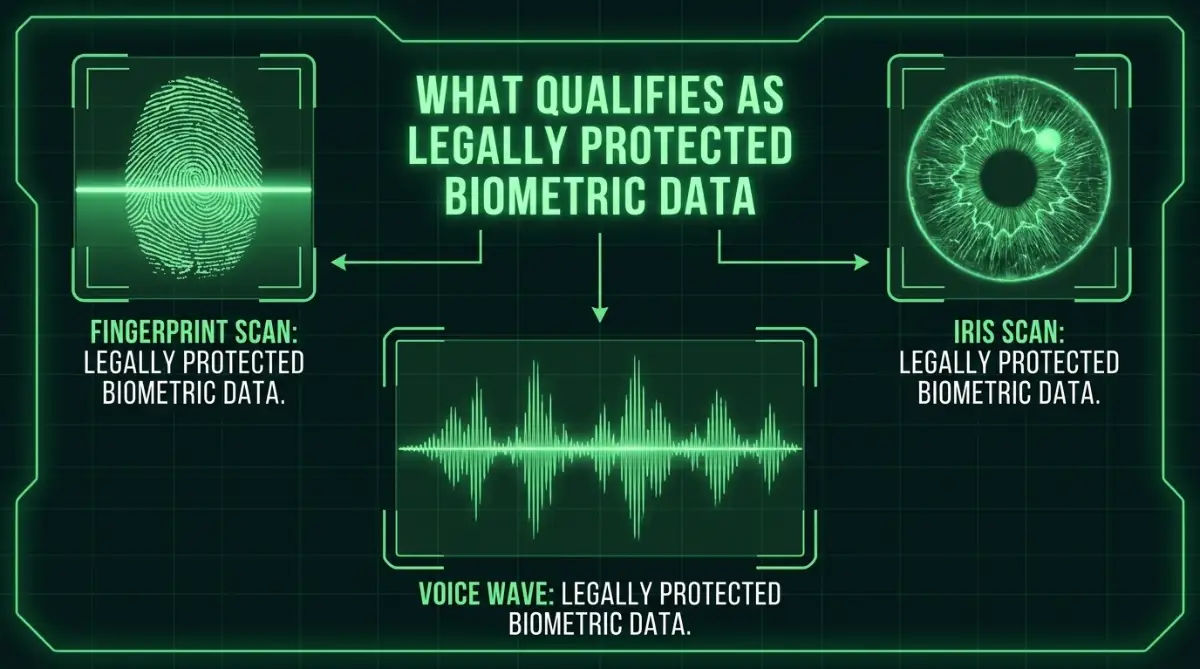
Unlike a stolen password, a person cannot simply reset their fingerprint or their face. Because physical characteristics are permanent, governments guard this information fiercely. I am going to show you exactly how different countries regulate this information and how you can build a legally secure digital perimeter around your business.
Understanding the Global Legal Frameworks
To protect your company, you must understand the rules governing your specific operating areas. You cannot apply a single, universal policy to a global workforce.
Every country views physical identity data through a completely different legal lens. We must break down the heaviest regulatory frameworks you will encounter.
The Weight of the European Union Rules
If you have employees or customers in Europe, you operate under the General Data Protection Regulation. The official European Commission GDPR guidelines classify biometrics as a "special category of personal data".
This classification means processing this data is universally prohibited by default. You can only collect it if you meet extremely strict, explicit exceptions. The user must give clear, unambiguous, and freely given consent.
You cannot bury this consent in a massive terms of service document. If you force a European employee to use a fingerprint scanner to enter the building without offering a reasonable alternative, you violate the law. The fines for this specific violation can reach up to four per cent of your total global corporate revenue.
Strict State-Level Mandates in America
The United States does not have a single federal law governing physical data. Instead, you face a chaotic patchwork of individual state laws.
The most terrifying regulation for business owners is the Biometric Information Privacy Act (BIPA) in Illinois. BIPA grants citizens a "private right of action". This means ordinary people can sue your company directly for thousands of dollars per violation, without needing the state attorney general to step in.
If you use a time clock software that scans the faces of one hundred employees in Chicago without written consent, you face guaranteed financial ruin. You must actively work to safeguard biometric data privacy on a state-by-state level to avoid these aggressive courtroom battles.

The Danger of Cross-Border Data Transfers
Collecting the information legally is only the first step. The moment you move that information from one country to another, you trigger a second layer of heavy regulation.
Many countries believe that if their citizen's data leaves their borders, it loses its legal protection.
Where Your Servers Actually Live
Imagine an employee in London scans their face to log into your company portal. Your company is headquartered in Texas, and your cloud servers sit in Ohio.
By sending that facial scan from the United Kingdom to the United States, you execute a cross-border data transfer. Under European law, you cannot send special category data to a country that lacks "adequate" privacy protections. The European Union routinely determines that US surveillance practices fail to meet their privacy standards.
To solve this, international companies use a strategy called 'data localisation'. They rent physical server space inside the European Union. The employee's facial scan stays entirely within Europe, completely bypassing the international transfer rules.
Managing these server locations is technically difficult but absolutely necessary. It requires the same structural discipline as securing remote work devices against silent data leaks. You have to control exactly where your sensitive files live physically.
This table clearly illustrates how the exact same corporate action triggers completely different financial penalties depending entirely on geography.

Pro-Level Strategies for Corporate Compliance
You cannot run a modern global business on hope and assumptions. You must build verifiable administrative systems.
Professional compliance officers do not treat privacy as an afterthought. They integrate strict legal rules directly into the daily software engineering process.
Enforcing Strict Opt-In Consent
Your legal safety relies entirely on clarity. When you ask a user for their fingerprint, you must explain exactly why you need it, how long you will keep it, and who else will see it.
You must separate this request from your general privacy policy. Provide a standalone checkbox that the user must actively click. We call this a transparent approach. Practising this transparency aligns perfectly with ethical zero-party data collection. You build profound trust with your users when you respect their physical boundaries openly.
Implementing Routine Data Destruction
Storing sensitive identity markers forever is a massive legal liability. If you do not need the data, you must delete it immediately.
Set up automated destruction schedules within your database. If an employee quits, their facial recognition template must automatically purge from your system within twenty-four hours. For security hardware, review the official cryptographic management guidelines published by the National Institute of Standards and Technology (NIST) to ensure you wipe the records permanently.

Common Mistakes That Trigger Massive Fines
When corporate executives try to modernise their offices, they often rush the deployment. They install new hardware without consulting their legal teams. This impatience creates devastating blind spots.
Let us examine the exact mistakes that routinely cause million-dollar settlements.
Assuming Employee Consent is Automatic
Business owners frequently assume that employees forfeit their privacy rights when they sign an employment contract. This is factually and legally incorrect.
You cannot force an employee to hand over their fingerprint to receive their pay cheque. In heavily regulated regions, consent is only valid if it is freely given. If an employee feels they will be fired for refusing a facial scan, their consent is legally invalid under duress.
You must offer reasonable alternatives. If you use a biometric time clock, you must also provide a traditional PIN code or a physical swipe card option.
Relying on Third-Party Vendor Promises
You might purchase a cutting-edge security camera system from a third-party software vendor. The vendor salesperson promises you that their system is "one hundred per cent compliant".
You believe them, install the cameras, and start scanning customers. When the lawsuit arrives, the vendor will point to the fine print in their contract that pushes all legal liability directly back onto your company.
You are ultimately responsible for the tools you deploy. You must demand to see a Data Processing Agreement (DPA) before signing a contract. You need absolute written proof that the vendor destroys the data properly and never sells it to outside marketing agencies.

Your Final Action Plan
You now possess the strategic clarity to manage global identity data safely. You understand that international borders dictate incredibly strict handling rules for physical characteristics.
Do not let the fear of lawsuits stop your company from innovating. You simply need to build a protective administrative framework before you deploy new hardware.
Your Immediate Compliance Checklist:
- Audit Existing Hardware: Walk through your office today. Identify every single time clock, security camera, and laptop that currently captures physical identity markers.
- Update Your Consent Forms: Draft a clear, standalone opt-in document for your staff. Explain exactly how the hardware works and provide an alternative option for those who opt out.
- Check Server Locations: Contact your cloud hosting provider. Verify the exact geographic location of the servers storing your international data to ensure local sovereignty compliance.
- Implement Auto-Deletion: Work with your IT department to program automatic data purging. Set the system to permanently wipe templates the moment a user account goes inactive.
Protecting physical identity data is a profound ethical responsibility. By respecting the laws of the regions where you operate, you build immense trust with your workforce and your customers. Take control of your compliance strategy today and secure your business against regulatory disaster.
Frequently Asked Questions
Is a normal photograph considered biometric data?
Under most global laws, a standard photograph is not considered biometric data on its own. It only becomes legally protected biometric data when you use specialised software to process that image for the purpose of uniquely identifying the individual.
Does the GDPR apply to American companies?
Yes. If your American company offers goods, services, or software platforms to individuals residing within the European Union, you are legally bound by GDPR regulations regarding their personal information.
How long can I legally keep biometric records?
Most strict privacy laws require you to destroy the information immediately when the original purpose for collecting it has been satisfied, or within a maximum of three years of the individual's last interaction with your company.
Disclaimer: This blog post is designed for educational and informational purposes only. I am not a certified data privacy attorney or a legal compliance officer. International data sovereignty laws, such as the GDPR, BIPA, and CCPA, are highly complex and subject to frequent legislative changes. Always consult with qualified legal counsel and a dedicated corporate compliance officer before deploying physical identity scanning technology or transferring user data across international borders.

Driven by a passion for information synthesis, I research complex digital systems, financial rules, health trends, and smart technology to distil dense topics into clear, transparent, and easy-to-understand guides for everyday readers.
Every guide here is built on research from official documentation, verified reports, and primary sources and reviewed for accuracy before publication. On topics involving legal, financial, or medical decisions, I write to inform, always encouraging readers to consult a licensed professional before acting.